

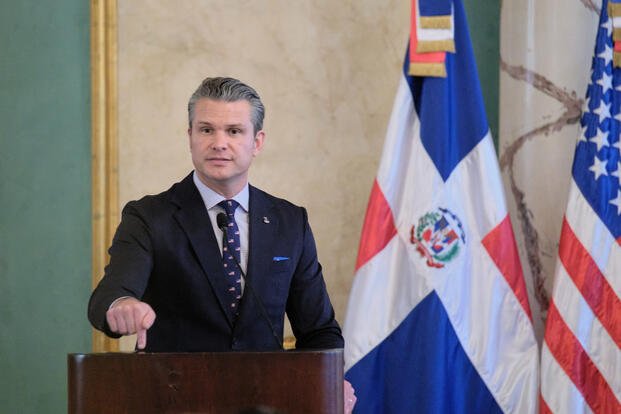
Defense Secretary Pete Hegseth, following the first striking of a boat in the Caribbean in September, issued a verbal directive to U.S. service members to "kill everybody" with a second strike that would leave no survivors, according to a new report from the Washington Post. The secretary strongly refutes such claims.
The Post reported that the second strike was conducted at Hegseth’s discretion and carried out by the counterterror group SEAL Team 6 after two survivors of a vessel allegedly carrying narcotics were spotted. The vessel originally held 11 individuals before it was struck by a missile off the coast of Trinidad.
“The order was to kill everybody,” one of two people with direct knowledge of the operation told the Post.
A Pentagon spokesperson told Military.com Friday afternoon that it had no comment on the Post report, and it declined to comment further on operations involving the Caribbean and vessel strikes.
Hegseth issued his own remarks later that day, referring to the Post report as "fake news delivering more fabricated, inflammatory, and derogatory reporting to discredit our incredible warriors fighting to protect the homeland."
"As we’ve said from the beginning, and in every statement, these highly effective strikes are specifically intended to be 'lethal, kinetic strikes,'" Hegseth said. "The declared intent is to stop lethal drugs, destroy narco-boats, and kill the narco-terrorists who are poisoning the American people. Every trafficker we kill is affiliated with a Designated Terrorist Organization.
"The Biden administration preferred the kid gloves approach, allowing millions of people—including dangerous cartels and unvetted Afghans—to flood our communities with drugs and violence. The Trump administration has sealed the border and gone on offense against narco-terrorists. Biden coddled terrorists, we kill them."

He added that current U.S. operations in the Caribbean are "lawful under both U.S. and international law, with all actions in compliance with the law of armed conflict—and approved by the best military and civilian lawyers, up and down the chain of command."
Chief Pentagon spokesperson Sean Parnell declined to address questions about Hegseth’s order and other details of the operation, according to the Post.
“This entire narrative is completely false,” Parnell said in a statement. “Ongoing operations to dismantle narcoterrorism and to protect the Homeland from deadly drugs have been a resounding success.”
Protocol Change
Adm. Frank M. "Mitch" Bradley was reportedly the commander who oversaw the mission from Fort Bragg and, according to the Post, told others on a secure conference call that the second strike was necessary because survivors were still legitimate targets and could have called other drug traffickers to retrieve them and any leftover cargo.
Bradley reportedly ordered the second strike "to fulfill Hegseth’s directive that everyone must be killed." Those two survivors were killed while in the water.
Protocols supposedly were altered following the Sept. 2 incident, directing U.S. military to rescue survivors rather than kill them. In a strike on October 16 in the Caribbean, two men who survived a strike were captured and later sent to Ecuador and Colombia.
U.S. forces have downed at least 22 vessels since September, killing a minimum of 83 people. President Donald Trump and Hegseth have maintained that operations in the Caribbean are a response to “narco-traffickers” who they claim aspire to bring illegal drugs into the United States.
The actions have sparked tensions as critics say the escalation in the region is part of a broader military framework to potentially remove embattled Venezuelan President Nicolás Maduro.
Trump and Maduro spoke last week via phone about a potential in-person meeting, according to multiple new reports.
Colombian President Gustavo Petro has criticized the U.S. for its actions in the Caribbean, proposing similar in-person meetings with regional partners and of course the U.S.
The White House responded in jest, with a spokesperson previously telling Military.com that Petro “is an illegal drug leader strongly encouraging the massive production of drugs.”
UPDATED 11/29/25, 9:36 a.m. ET: This story was updated with comment from Defense Secretary Pete Hegseth and additional information.





